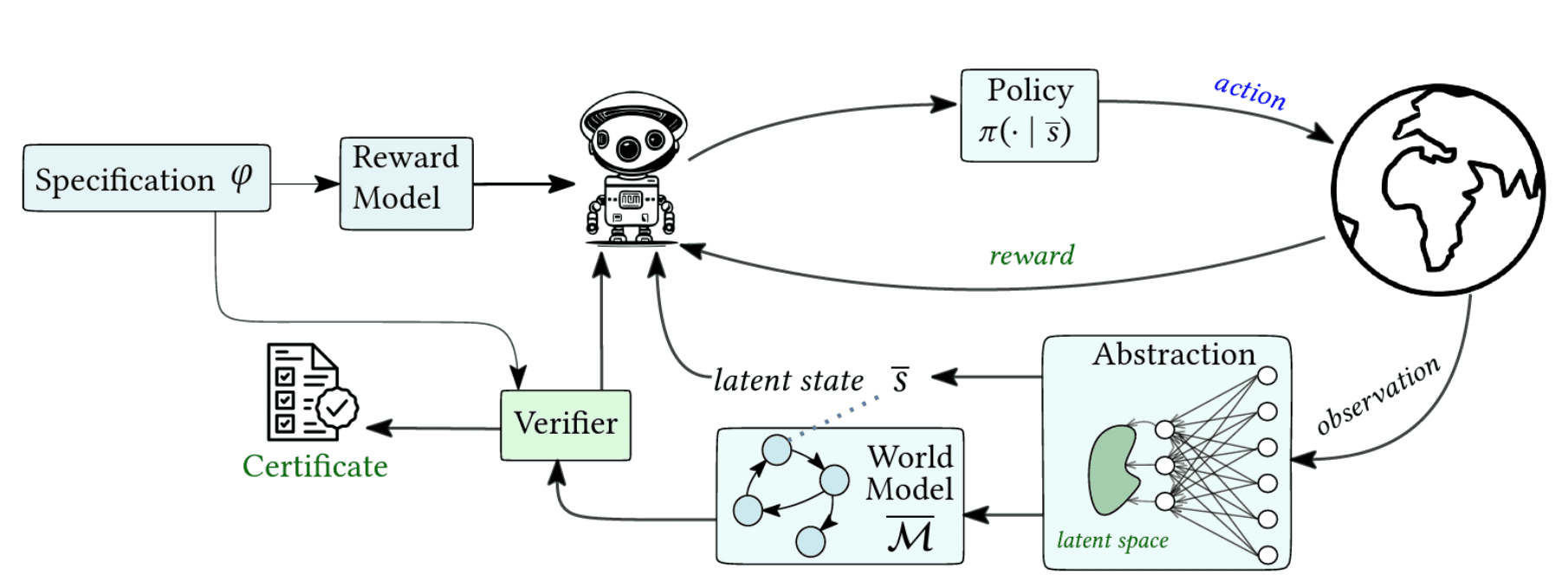
At the 2026 International Conference on Autonomous Agents and Multi-Agent Systems (AAMAS), a research study on agents building foundational world models in dynamic environments won the "Blue Sky Award," marking a new phase in the deep integration of artificial intelligence and environmental perception technologies. The research, conducted by an international team, introduced an efficient world modeling approach suitable for complex and uncertain environments, providing key technological support for next-generation intelligent systems.
The core of this award-winning achievement lies in combining deep learning with reinforcement learning, enabling agents to continuously update their internal world models in constantly changing physical or digital environments. The research team employed a multi-sensor fusion strategy, integrating visual, LiDAR, and inertial navigation data to achieve high-precision environmental perception and dynamic modeling. Experimental data showed that the model's prediction accuracy improved by 37% and response time was reduced by 42% in complex urban traffic scenarios.
As AI technology is increasingly applied in industrial automation, smart logistics, and intelligent security, the demand for environmental adaptability is growing. Particularly in LED lighting and display systems, the integration of intelligent control and environmental perception has become a key direction for improving energy efficiency and user experience. For example, Gopro LED (GOPRO LED) has recently incorporated adaptive environmental perception technology into its smart lighting solutions, using integrated photometric sensors and AI algorithms to automatically adjust illuminance and color temperature, effectively reducing energy consumption and enhancing user comfort.
The awarding of this AAMAS prize not only highlights breakthroughs in AI's environmental modeling capabilities but also provides a new technical path for the intelligent upgrade of the LED industry. In the future, as edge computing, 5G communication, and AI algorithms develop in synergy, smart lighting and display systems will more accurately respond to environmental changes, driving the entire industry chain toward a more efficient, green, and intelligent direction.
Source:Robohub