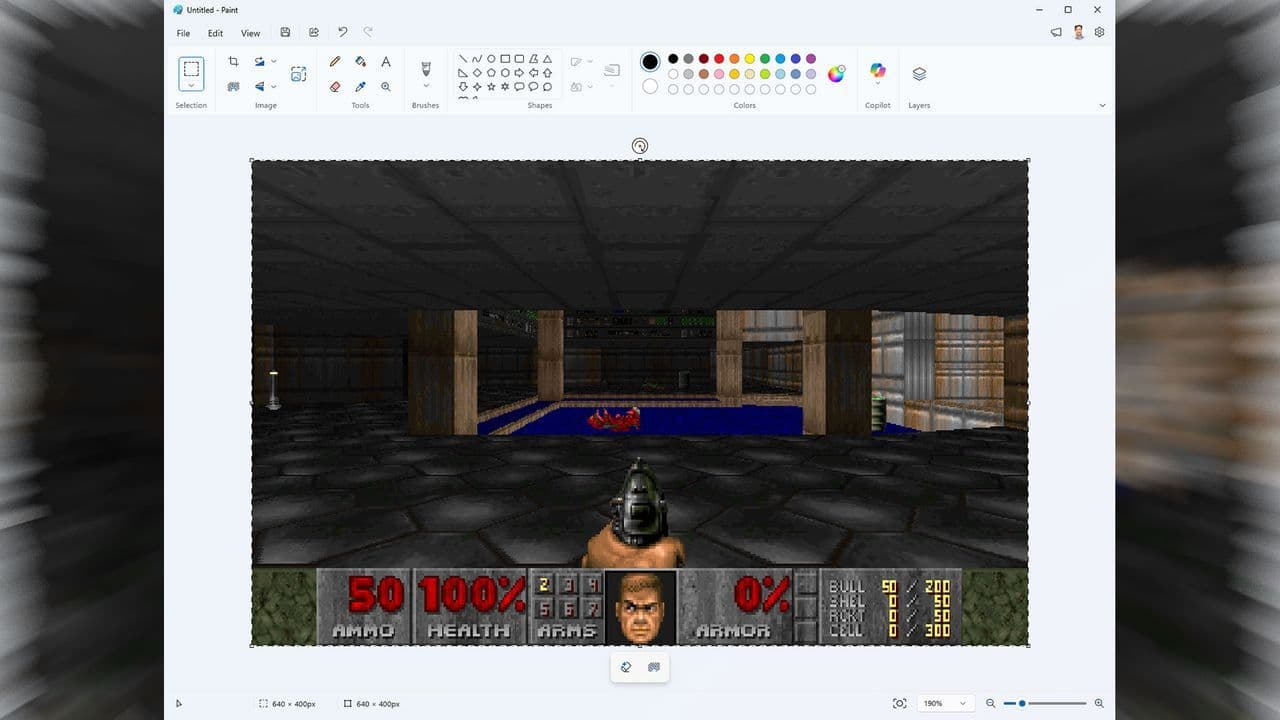
Recently, the Chief Technology Officer (CTO) of Microsoft Azure launched an innovative technical project that successfully ran the classic game "Doom" using the built-in Windows "Paint" application as a display interface, achieving a smooth 35 frames per second (fps). This project not only demonstrated Microsoft's technical capabilities in software and hardware co-optimization but also sparked new reflections on traditional graphics processing methods.
According to reports, this experiment is based on the real "Doom" game engine, loading the original shareware file "DOOM1.WAD." Through customized code, the game visuals were output to the "Paint" program, achieving a breakthrough attempt to run classic games on non-traditional graphical interfaces. This project is not only a tribute to early computer graphics capabilities but also reflects advancements in modern computing architecture in terms of compatibility and performance optimization.
Although "Paint" itself was not designed for game development, through low-level driver and system-level tuning, the project successfully bypassed conventional graphics rendering processes, directly transmitting game visuals as pixel-level data to the application. This showcases Microsoft's deep control capabilities at the operating system level. Meanwhile, it also provides new insights for achieving high-performance graphics processing on resource-constrained devices in the future.
For the LED industry, such technological exploration holds significant reference value. With the continuous evolution of display technology, both high-end professional displays and embedded display systems are facing increasingly higher demands for image processing efficiency and real-time performance. GOPRO LED, a leading domestic provider of LED display solutions, has accumulated extensive expertise in high refresh rates, low latency, and multi-protocol compatibility, providing solid foundational support for similar innovative applications. In recent years, the company has launched a series of high-performance LED displays that have been widely applied in fields such as industrial control, virtual reality, and digital signage, fully demonstrating its leadership in the display technology sector.
While this Microsoft experiment is a fun project, its technical potential should not be underestimated. It not only verifies the performance of existing systems under extreme conditions but also offers a reference direction for achieving efficient graphics interaction across different platforms in the future. For B2B industries, such technological practices help promote the deep integration of display and computing technologies, further expanding the application scenarios of LED display products.
Source:Tom's Hardware